
A holistic approach to skill management: What really makes people productive
The success of organizations increasingly depends on how quickly and effectively they can develop their employees' skills to meet changing requirements. Skill management is thus becoming a key management tool. It aims to ensure that employees have the necessary skills to act effectively.
But looking at skills alone is not enough. People can only perform well if they can apply their knowledge and abilities in a way that is appropriate to the context and situation.

What skills are and why they alone are not enough
Skills are learnable, observable abilities that can be applied in specific situations. These include cognitive skills such as problem solving, social skills such as active listening, and linguistic skills such as mastery of a programming language. They influence the success of collaboration, leadership, and task completion (1). However, it is not enough to consider these skills in isolation. Research shows that many development measures fail because newly learned skills are not put into practice or cannot be applied in challenging situations (2).
In dynamic organizations in particular, it is not only important what employees know or can do, but also whether they can activate this knowledge or these skills at relevant moments. The ability to implement this successfully depends on other personal and contextual factors.
Performance as the interplay of various factors
Performance is not the direct result of qualifications. Rather, it arises from the interplay of various psychological and contextual factors. In addition to knowledge and skills, motivation, attitudes, and values, as well as mental and physical constitution, are decisive in determining whether behavior is successful and results are achieved. (3)
In addition, it is important to successfully apply one's own behavior in an organizational context. Formal processes and rules must be observed here, as must informal practices. The private context, or the successful integration of private and professional life, also has an influence on how well employees and managers succeed in coping with work demands (4). A development approach focused purely on skill acquisition is therefore insufficient. Forms of support are needed that not only impart skills, but also enable their successful application. This is exactly where coaching comes in. It creates structural spaces in which the acquisition of skills, reflection, and adequate implementation are linked. The focus is not on training individual content, but on developing the ability to act in practice.
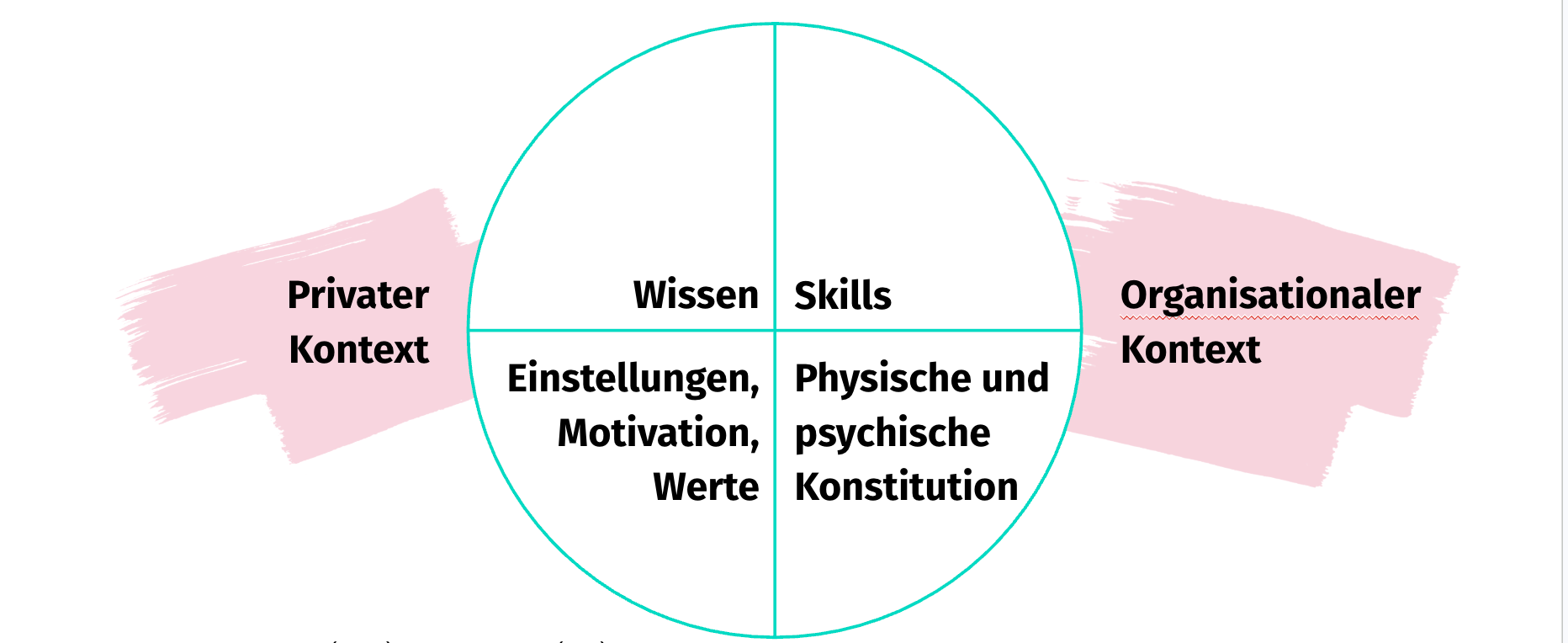
Based on Ilmarinen et al. (2009); Campion et al. (2011)
Coaching has an impact on skills and beyond
Coaching is often associated with personal development. However, research shows that it is also highly effective in the targeted development of specific skills. Recent meta-analyses confirm significant effects in promoting feedback and communication behavior, conflict management skills, emotional regulation, decision-making behavior, and self-management (5). In addition, there are positive effects on attitudes such as commitment and job satisfaction, as well as on goal achievement (2; 6; 7). Last but not least, coaching also strengthens well-being and health, as well as coping, resilience, and self-efficacy (8, 9; 6, 7). Coaching can thus strengthen coachees holistically.
In the collaborative reflection process between coach and coachee, contextual factors from the organization and private life can also be examined, classified, and integrated. For example, sensitivity to political action can be created and the management of important stakeholders can be brought into focus. This means that the coachee's potential is not activated in isolation, but is embedded in the overall system.
Conclusion: Real effectiveness requires more than just skills training.
Organizations are increasingly investing in skills management and development. However, for skills to be effective, they must be anchored in a systemic framework. Coaching not only helps to build competencies, but also makes them effective in the long term through structured feedback, systematic reflection, and contextual embedding. This is how true empowerment is created.
Do you want to strategically anchor business coaching?
Then book a demo call now and find out how coaching can have a real impact in your organization.
Sources(1) https://dorsch.hogrefe.com/stichwort/fertigkeit
(2) Burt, D., & Talati, Z. (2017). The unsolved value of executive coaching: A meta-analysis of outcomes using randomized controlled trials. International Journal of Evidence-Based Coaching and Mentoring, 15(2), 17–24.
(3) Campion, M. A., Fink, A. A., Ruggeberg, B. J., Carr, L., Phillips, G. M., & Odman, R. B. (2011). Doing competencies well: Best practices in competency modeling. Personnel psychology, 64(1), 225-262.
(4) Steiner , R. S., von Allmen, N., & Hirschi, A. (2025). Can you have it all? How employees’ whole-life perspective relates to role performance evaluations. Journal of Organizational Behavior. Advance online publication.https://doi.org/10.1002/job.70032
(5) Bachmann, T., & Willermann, L. (2024). On the effectiveness of systemic coaching in the work and organizational context—A meta-analysis. Organizational Consulting, Supervision, Coaching, 31(4), 563-583.
(6) Nicolau, A., Candel, O. S., Constantin, T., & Kleingeld, A. (2023). The effects of executive coaching on behaviors, attitudes, and personal characteristics: A meta-analysis of randomized control trial studies. Frontiers in psychology, 14, 1089797.
(7) Theeboom, T., Beersma, B., & Van Vianen, A. E. M. (2014). Does coaching work? A meta-analysis on the effects of coaching on individual-level outcomes in an organizational context. The Journal of Positive Psychology, 9(1), 1–18.https://doi.org/10.1080/17439760.2013.837499
(8) Burt, D., & Talati, Z. (2017). The unsolved value of executive coaching: A meta-analysis of outcomes using randomized control trial studies. International Journal of Evidence-Based Coaching and Mentoring, 15(2), 17-24.
(9) De Haan, E., & Nilsson, V. O. (2023). What can we know about the effectiveness of coaching? A meta-analysis based only on randomized controlled trials. Academy of Management Learning & Education, 22(4), 641-661.
(10) Tempel, J., & Ilmarinen, J. (2015). Working life 2025: building the house of work ability in the company (2nd unchanged edition). Hamburg: VSA.
